Measure of countable unions and intersections
Basic properties[edit]
Let be a measure.

Monotonicity[edit]
If and are measurable sets with then



Measure of countable unions and intersections[edit]
Subadditivity[edit]
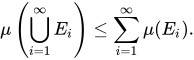
For any countable sequence of (not necessarily disjoint) measurable sets in



Continuity from below[edit]
If are measurable sets that are increasing (meaning that ) then the union of the sets is measurable and


Continuity from above[edit]
If are measurable sets that are decreasing (meaning that ) then the intersection of the sets is measurable; furthermore, if at least one of the has finite measure then

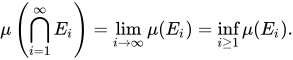
This property is false without the assumption that at least one of the has finite measure. For instance, for each let which all have infinite Lebesgue measure, but the intersection is empty.


Other properties[edit]
Completeness[edit]
A measurable set is called a null set if A subset of a null set is called a negligible set. A negligible set need not be measurable, but every measurable negligible set is automatically a null set. A measure is called complete if every negligible set is measurable.


A measure can be extended to a complete one by considering the σ-algebra of subsets which differ by a negligible set from a measurable set that is, such that the symmetric difference of and is contained in a null set. One defines to equal


μ{x : f(x) ≥ t} = μ{x : f(x) > t} (a.e.)[edit]
If is -measurable, then
![{\displaystyle f:X\to [0,+\infty ]}](https://wikimedia.org/api/rest_v1/media/math/render/svg/b309700f0faa34eb53e04f4cc81440cb0c97f753)
![{\displaystyle (\Sigma ,{\cal {B}}([0,+\infty ]))}](https://wikimedia.org/api/rest_v1/media/math/render/svg/ace7d9b472a9a1cc4185761a09a0be2d649f3ed7)


Both and are monotonically non-increasing functions of so both of them have at most countably many discontinuities and thus they are continuous almost everywhere, relative to the Lebesgue measure. If then so that as desired.






If is such that then monotonicity implies








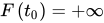

For let be a monotonically non-decreasing sequence converging to The monotonically non-increasing sequence of members of has at least one finitely -measurable component, and









Additivity[edit]
Measures are required to be countably additive. However, the condition can be strengthened as follows. For any set and any set of nonnegative define:




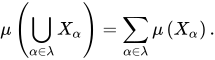
A measure on is -additive if for any and any family of disjoint sets the following hold:


Sigma-finite measures[edit]
A measure space is called finite if is a finite real number (rather than ). Nonzero finite measures are analogous to probability measures in the sense that any finite measure is proportional to the probability measure A measure is called σ-finite if can be decomposed into a countable union of measurable sets of finite measure. Analogously, a set in a measure space is said to have a σ-finite measure if it is a countable union of sets with finite measure.


For example, the real numbers with the standard Lebesgue measure are σ-finite but not finite. Consider the closed intervals for all integers there are countably many such intervals, each has measure 1, and their union is the entire real line. Alternatively, consider the real numbers with the counting measure, which assigns to each finite set of reals the number of points in the set. This measure space is not σ-finite, because every set with finite measure contains only finitely many points, and it would take uncountably many such sets to cover the entire real line. The σ-finite measure spaces have some very convenient properties; σ-finiteness can be compared in this respect to the Lindelöf property of topological spaces.[original research?] They can be also thought of as a vague generalization of the idea that a measure space may have 'uncountable measure'.
![{\displaystyle [k,k+1]}](https://wikimedia.org/api/rest_v1/media/math/render/svg/7e1af0d6f107bc5024098afad364e79c12bf0042)

Comments
Post a Comment