Measure
Measure (mathematics)
 | This article includes a list of general references, but it lacks sufficient corresponding inline citations. (January 2021) |
.svg)


In mathematics, the concept of a measure is a generalization and formalization of geometrical measures (length, area, volume) and other common notions, such as mass and probability of events. These seemingly distinct concepts have many similarities and can often be treated together in a single mathematical context. Measures are foundational in probability theory, integration theory, and can be generalized to assume negative values, as with electrical charge. Far-reaching generalizations (such as spectral measures and projection-valued measures) of measure are widely used in quantum physics and physics in general.
The intuition behind this concept dates back to ancient Greece, when Archimedes tried to calculate the area of a circle. But it was not until the late 19th and early 20th centuries that measure theory became a branch of mathematics. The foundations of modern measure theory were laid in the works of Émile Borel, Henri Lebesgue, Nikolai Luzin, Johann Radon, Constantin Carathéodory, and Maurice Fréchet, among others.
Definition[edit]


Let be a set and a -algebra over A set function from to the extended real number line is called a measure if it satisfies the following properties:


- Non-negativity: For all in we have
- Null empty set:
- Countable additivity (or -additivity): For all countable collections of pairwise disjoint sets in Σ,


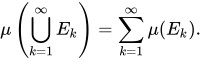
If at least one set has finite measure, then the requirement is met automatically due to countable additivity:


If the condition of non-negativity is dropped, and takes on at most one of the values of then is called a signed measure.

The pair is called a measurable space, and the members of are called measurable sets.

A triple is called a measure space. A probability measure is a measure with total measure one – that is, A probability space is a measure space with a probability measure.


For measure spaces that are also topological spaces various compatibility conditions can be placed for the measure and the topology. Most measures met in practice in analysis (and in many cases also in probability theory) are Radon measures. Radon measures have an alternative definition in terms of linear functionals on the locally convex topological vector space of continuous functions with compact support. This approach is taken by Bourbaki (2004) and a number of other sources. For more details, see the article on Radon measures.
Instances[edit]
Some important measures are listed here.
- The counting measure is defined by = number of elements in
- The Lebesgue measure on is a complete translation-invariant measure on a σ-algebra containing the intervals in such that ; and every other measure with these properties extends Lebesgue measure.
- Circular angle measure is invariant under rotation, and hyperbolic angle measure is invariant under squeeze mapping.
- The Haar measure for a locally compact topological group is a generalization of the Lebesgue measure (and also of counting measure and circular angle measure) and has similar uniqueness properties.
- The Hausdorff measure is a generalization of the Lebesgue measure to sets with non-integer dimension, in particular, fractal sets.
- Every probability space gives rise to a measure which takes the value 1 on the whole space (and therefore takes all its values in the unit interval [0, 1]). Such a measure is called a probability measure. See probability axioms.
- The Dirac measure δa (cf. Dirac delta function) is given by δa(S) = χS(a), where χS is the indicator function of The measure of a set is 1 if it contains the point and 0 otherwise.


![{\displaystyle \mu ([0,1])=1}](https://wikimedia.org/api/rest_v1/media/math/render/svg/bde58701848b4874a1a32e287f66c80eb2b691ed)

Other 'named' measures used in various theories include: Borel measure, Jordan measure, ergodic measure, Gaussian measure, Baire measure, Radon measure, Young measure, and Loeb measure.
In physics an example of a measure is spatial distribution of mass (see for example, gravity potential), or another non-negative extensive property, conserved (see conservation law for a list of these) or not. Negative values lead to signed measures, see "generalizations" below.
- Liouville measure, known also as the natural volume form on a symplectic manifold, is useful in classical statistical and Hamiltonian mechanics.
- Gibbs measure is widely used in statistical mechanics, often under the name canonical ensemble.

Comments
Post a Comment