Strictly localizable measures
Strictly localizable measures[edit]
Semifinite measures[edit]
Let be a set, let be a sigma-algebra on and let be a measure on We say is semifinite to mean that for all [2]




Semifinite measures generalize sigma-finite measures, in such a way that some big theorems of measure theory that hold for sigma-finite but not arbitrary measures can be extended with little modification to hold for semifinite measures. (To-do: add examples of such theorems; cf. the talk page.)
Basic examples[edit]
- Every sigma-finite measure is semifinite.
- Assume let and assume for all
- We have that is sigma-finite if and only if for all and is countable. We have that is semifinite if and only if for all [3]
- Taking above (so that is counting measure on ), we see that counting measure on is
- sigma-finite if and only if is countable; and
- semifinite (without regard to whether is countable). (Thus, counting measure, on the power set of an arbitrary uncountable set gives an example of a semifinite measure that is not sigma-finite.)
- Let be a complete, separable metric on let be the Borel sigma-algebra induced by and let Then the Hausdorff measure is semifinite.[4]
- Let be a complete, separable metric on let be the Borel sigma-algebra induced by and let Then the packing measure is semifinite.[5]

![{\displaystyle f:X\to [0,+\infty ],}](https://wikimedia.org/api/rest_v1/media/math/render/svg/adddcafd3ba33a65329e65c136223ef83197abe5)




Involved example[edit]
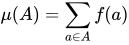
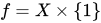
The zero measure is sigma-finite and thus semifinite. In addition, the zero measure is clearly less than or equal to It can be shown there is a greatest measure with these two properties:


We say the semifinite part of to mean the semifinite measure defined in the above theorem. We give some nice, explicit formulas, which some authors may take as definition, for the semifinite part:




Since is semifinite, it follows that if then is semifinite. It is also evident that if is semifinite then


Non-examples[edit]
Every measure that is not the zero measure is not semifinite. (Here, we say measure to mean a measure whose range lies in : ) Below we give examples of measures that are not zero measures.



- Let be nonempty, let be a -algebra on let be not the zero function, and let It can be shown that is a measure.
- Let be uncountable, let be a -algebra on let be the countable elements of and let It can be shown that is a measure.[2]








Involved non-example[edit]



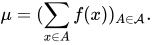
We say the part of to mean the measure defined in the above theorem. Here is an explicit formula for :



Results regarding semifinite measures[edit]
- Let be or and let Then is semifinite if and only if is injective.[13][14] (This result has import in the study of the dual space of .)
- Let be or and let be the topology of convergence in measure on Then is semifinite if and only if is Hausdorff.[15][16]
- (Johnson) Let be a set, let be a sigma-algebra on let be a measure on let be a set, let be a sigma-algebra on and let be a measure on If are both not a measure, then both and are semifinite if and only if for all and (Here, is the measure defined in Theorem 39.1 in Berberian '65.[17])








Comments
Post a Comment