Metric space
Metric space


In mathematics, a metric space is a set together with a notion of distance between its elements, usually called points. The distance is measured by a function called a metric or distance function.[1] Metric spaces are the most general setting for studying many of the concepts of mathematical analysis and geometry.
The most familiar example of a metric space is 3-dimensional Euclidean space with its usual notion of distance. Other well-known examples are a sphere equipped with the angular distance and the hyperbolic plane. A metric may correspond to a metaphorical, rather than physical, notion of distance: for example, the set of 100-character Unicode strings can be equipped with the Hamming distance, which measures the number of characters that need to be changed to get from one string to another.
Since they are very general, metric spaces are a tool used in many different branches of mathematics. Many types of mathematical objects have a natural notion of distance and therefore admit the structure of a metric space, including Riemannian manifolds, normed vector spaces, and graphs. In abstract algebra, the p-adic numbers arise as elements of the completion of a metric structure on the rational numbers. Metric spaces are also studied in their own right in metric geometry[2] and analysis on metric spaces.[3]
Many of the basic notions of mathematical analysis, including balls, completeness, as well as uniform, Lipschitz, and Hölder continuity, can be defined in the setting of metric spaces. Other notions, such as continuity, compactness, and open and closed sets, can be defined for metric spaces, but also in the even more general setting of topological spaces.
Definition and illustration[edit]
Motivation[edit]

To see the utility of different notions of distance, consider the surface of the Earth as a set of points. We can measure the distance between two such points by the length of the shortest path along the surface, "as the crow flies"; this is particularly useful for shipping and aviation. We can also measure the straight-line distance between two points through the Earth's interior; this notion is, for example, natural in seismology, since it roughly corresponds to the length of time it takes for seismic waves to travel between those two points.
The notion of distance encoded by the metric space axioms has relatively few requirements. This generality gives metric spaces a lot of flexibility. At the same time, the notion is strong enough to encode many intuitive facts about what distance means. This means that general results about metric spaces can be applied in many different contexts.
Like many fundamental mathematical concepts, the metric on a metric space can be interpreted in many different ways. A particular metric may not be best thought of as measuring physical distance, but, instead, as the cost of changing from one state to another (as with Wasserstein metrics on spaces of measures) or the degree of difference between two objects (for example, the Hamming distance between two strings of characters, or the Gromov–Hausdorff distance between metric spaces themselves).
Definition[edit]
Formally, a metric space is an ordered pair (M, d) where M is a set and d is a metric on M, i.e., a function


- The distance from a point to itself is zero:Intuitively, it never costs anything to travel from a point to itself.
- (Positivity) The distance between two distinct points is always positive:
- (Symmetry) The distance from x to y is always the same as the distance from y to x:This excludes asymmetric notions of "cost" which arise naturally from the observation that it's harder to walk uphill than downhill.
- The triangle inequality holds:This is a natural property of both physical and metaphorical notions of distance: you can arrive at z from x by taking a detour through y, but this will not make your journey any faster than the shortest path.




If the metric d is unambiguous, one often refers by abuse of notation to "the metric space M".
Simple examples[edit]
The real numbers[edit]
The real numbers with the distance function given by the absolute difference form a metric space. Many properties of metric spaces and functions between them are generalizations of concepts in real analysis and coincide with those concepts when applied to the real line.

Metrics on Euclidean spaces[edit]
The Euclidean plane can be equipped with many different metrics. The Euclidean distance familiar from school mathematics can be defined by


The taxicab or Manhattan distance is defined by

The maximum, , or Chebyshev distance is defined by


In fact, these three distances, while they have distinct properties, are similar in some ways. Informally, points that are close in one are close in the others, too. This observation can be quantified with the formula


A radically different distance can be defined by setting
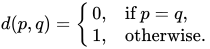
All of these metrics make sense on as well as .

Subspaces[edit]
Given a metric space (M, d) and a subset , we can consider A to be a metric space by measuring distances the same way we would in M. Formally, the induced metric on A is a function defined by




History[edit]
![[icon]](https://en.wikipedia.org/wiki/File:Wiki_letter_w_cropped.svg)
In 1906 Maurice Fréchet introduced metric spaces in his work Sur quelques points du calcul fonctionnel[6] in the context of functional analysis: his main interest was in studying the real-valued functions from a metric space, generalizing the theory of functions of several or even infinitely many variables, as pioneered by mathematicians such as Cesare Arzelà. The idea was further developed and placed in its proper context by Felix Hausdorff in his magnum opus Principles of Set Theory, which also introduced the notion of a (Hausdorff) topological space.[7]
General metric spaces have become a foundational part of the mathematical curriculum.[8] Prominent examples of metric spaces in mathematical research include Riemannian manifolds and normed vector spaces, which are the domain of differential geometry and functional analysis, respectively.[9] Fractal geometry is a source of some exotic metric spaces. Others have arisen as limits through the study of discrete or smooth objects, including scale-invariant limits in statistical physics, Alexandrov spaces arising as Gromov–Hausdorff limits of sequences of Riemannian manifolds, and boundaries and asymptotic cones in geometric group theory. Finally, many new applications of finite and discrete metric spaces have arisen in computer science.
Basic notions[edit]
A distance function is enough to define notions of closeness and convergence that were first developed in real analysis. Properties that depend on the structure of a metric space are referred to as metric properties. Every metric space is also a topological space, and some metric properties can also be rephrased without reference to distance in the language of topology; that is, they are really topological properties.
The topology of a metric space[edit]
For any point x in a metric space M and any real number r > 0, the open ball of radius r around x is defined to be the set of points that are at most distance r from x:


An open set is a set which is a neighborhood of all its points. It follows that the open balls form a base for a topology on M. In other words, the open sets of M are exactly the unions of open balls. As in any topology, closed sets are the complements of open sets. Sets may be both open and closed as well as neither open nor closed.
This topology does not carry all the information about the metric space. For example, the distances d1, d2, and d∞ defined above all induce the same topology on , although they behave differently in many respects. Similarly, with the Euclidean metric and its subspace the interval (0, 1) with the induced metric are homeomorphic but have very different metric properties.

Conversely, not every topological space can be given a metric. Topological spaces which are compatible with a metric are called metrizable and are particularly well-behaved in many ways: in particular, they are paracompact[10] Hausdorff spaces[11] (hence normal) and first-countable.[b] The Nagata–Smirnov metrization theorem gives a characterization of metrizability in terms of other topological properties, without reference to metrics.
Convergence[edit]
Convergence of sequences in Euclidean space is defined as follows:
- A sequence (xn) converges to a point x if for every ε > 0 there is an integer N such that for all n > N, d(xn, x) < ε.
Convergence of sequences in a topological space is defined as follows:
- A sequence (xn) converges to a point x if for every open set U containing x there is an integer N such that for all n > N, .

In metric spaces, both of these definitions make sense and they are equivalent. This is a general pattern for topological properties of metric spaces: while they can be defined in a purely topological way, there is often a way that uses the metric which is easier to state or more familiar from real analysis.
Completeness[edit]
Informally, a metric space is complete if it has no "missing points": every sequence that looks like it should converge to something actually converges.
To make this precise: a sequence (xn) in a metric space M is Cauchy if for every ε > 0 there is an integer N such that for all m, n > N, d(xm, xn) < ε. By the triangle inequality, any convergent sequence is Cauchy: if xm and xn are both less than ε away from the limit, then they are less than 2ε away from each other. If the converse is true—every Cauchy sequence in M converges—then M is complete.
Euclidean spaces are complete, as is with the other metrics described above. Two examples of spaces which are not complete are (0, 1) and the rationals, each with the metric induced from . One can think of (0, 1) as "missing" its endpoints 0 and 1. The rationals are missing all the irrationals, since any irrational has a sequence of rationals converging to it in (for example, its successive decimal approximations). These examples show that completeness is not a topological property, since is complete but the homeomorphic space (0, 1) is not.
This notion of "missing points" can be made precise. In fact, every metric space has a unique completion, which is a complete space that contains the given space as a dense subset. For example, [0, 1] is the completion of (0, 1), and the real numbers are the completion of the rationals.
Since complete spaces are generally easier to work with, completions are important throughout mathematics. For example, in abstract algebra, the p-adic numbers are defined as the completion of the rationals under a different metric. Completion is particularly common as a tool in functional analysis. Often one has a set of nice functions and a way of measuring distances between them. Taking the completion of this metric space gives a new set of functions which may be less nice, but nevertheless useful because they behave similarly to the original nice functions in important ways. For example, weak solutions to differential equations typically live in a completion (a Sobolev space) rather than the original space of nice functions for which the differential equation actually makes sense.
Bounded and totally bounded spaces[edit]

A metric space M is bounded if there is an r such that no pair of points in M is more than distance r apart.[c] The least such r is called the diameter of M.
The space M is called precompact or totally bounded if for every r > 0 there is a finite cover of M by open balls of radius r. Every totally bounded space is bounded. To see this, start with a finite cover by r-balls for some arbitrary r. Since the subset of M consisting of the centers of these balls is finite, it has finite diameter, say D. By the triangle inequality, the diameter of the whole space is at most D + 2r. The converse does not hold: an example of a metric space that is bounded but not totally bounded is (or any other infinite set) with the discrete metric.

Comments
Post a Comment