Compactness
Compactness[edit]
Compactness is a topological property which generalizes the properties of a closed and bounded subset of Euclidean space. There are several equivalent definitions of compactness in metric spaces:
- A metric space M is compact if every open cover has a finite subcover (the usual topological definition).
- A metric space M is compact if every sequence has a convergent subsequence. (For general topological spaces this is called sequential compactness and is not equivalent to compactness.)
- A metric space M is compact if it is complete and totally bounded. (This definition is written in terms of metric properties and doesn't make sense for a general topological space, but it is nevertheless topologically invariant since it is equivalent to compactness.)
One example of a compact space is the closed interval [0, 1].
Compactness is important for similar reasons to completeness: it makes it easy to find limits. Another important tool is Lebesgue's number lemma, which shows that for any open cover of a compact space, every point is relatively deep inside one of the sets of the cover.
Functions between metric spaces[edit]

Unlike in the case of topological spaces or algebraic structures such as groups or rings, there is no single "right" type of structure-preserving function between metric spaces. Instead, one works with different types of functions depending on one's goals. Throughout this section, suppose that and are two metric spaces. The words "function" and "map" are used interchangeably.


Isometries[edit]
One interpretation of a "structure-preserving" map is one that fully preserves the distance function:
- A function is distance-preserving[12] if for every pair of points x and y in M1,


It follows from the metric space axioms that a distance-preserving function is injective. A bijective distance-preserving function is called an isometry.[13] One perhaps non-obvious example of an isometry between spaces described in this article is the map defined by


If there is an isometry between the spaces M1 and M2, they are said to be isometric. Metric spaces that are isometric are essentially identical.
Continuous maps[edit]
On the other end of the spectrum, one can forget entirely about the metric structure and study continuous maps, which only preserve topological structure. There are several equivalent definitions of continuity for metric spaces. The most important are:
- Topological definition. A function is continuous if for every open set U in M2, the preimage is open.
- Sequential continuity. A function is continuous if whenever a sequence (xn) converges to a point x in M1, the sequence converges to the point f(x) in M2.



- (These first two definitions are not equivalent for all topological spaces.)
- ε–δ definition. A function is continuous if for every point x in M1 and every ε > 0 there exists δ > 0 such that for all y in M1 we have

A homeomorphism is a continuous map whose inverse is also continuous; if there is a homeomorphism between M1 and M2, they are said to be homeomorphic. Homeomorphic spaces are the same from the point of view of topology, but may have very different metric properties. For example, is unbounded and complete, while (0, 1) is bounded but not complete.

Uniformly continuous maps[edit]
A function is uniformly continuous if for every real number ε > 0 there exists δ > 0 such that for all points x and y in M1 such that , we have


The only difference between this definition and the ε–δ definition of continuity is the order of quantifiers: the choice of δ must depend only on ε and not on the point x. However, this subtle change makes a big difference. For example, uniformly continuous maps take Cauchy sequences in M1 to Cauchy sequences in M2. In other words, uniform continuity preserves some metric properties which are not purely topological.
On the other hand, the Heine–Cantor theorem states that if M1 is compact, then every continuous map is uniformly continuous. In other words, uniform continuity cannot distinguish any non-topological features of compact metric spaces.
Lipschitz maps and contractions[edit]
A Lipschitz map is one that stretches distances by at most a bounded factor. Formally, given a real number K > 0, the map is K-Lipschitz if

Lipschitz maps are particularly important in metric geometry, since they provide more flexibility than distance-preserving maps, but still make essential use of the metric.[14] For example, a curve in a metric space is rectifiable (has finite length) if and only if it has a Lipschitz reparametrization.
A 1-Lipschitz map is sometimes called a nonexpanding or metric map. Metric maps are commonly taken to be the morphisms of the category of metric spaces.
A K-Lipschitz map for K < 1 is called a contraction. The Banach fixed-point theorem states that if M is a complete metric space, then every contraction admits a unique fixed point. If the metric space M is compact, the result holds for a slightly weaker condition on f: a map admits a unique fixed point if


Quasi-isometries[edit]
A quasi-isometry is a map that preserves the "large-scale structure" of a metric space. Quasi-isometries need not be continuous. For example, and its subspace are quasi-isometric, even though one is connected and the other is discrete. The equivalence relation of quasi-isometry is important in geometric group theory: the Švarc–Milnor lemma states that all spaces on which a group acts geometrically are quasi-isometric.[15]


Formally, the map is a quasi-isometric embedding if there exist constants A ≥ 1 and B ≥ 0 such that

It is a quasi-isometry if in addition it is quasi-surjective, i.e. there is a constant C ≥ 0 such that every point in is at distance at most C from some point in the image .


Notions of metric space equivalence[edit]
Given two metric spaces and :
- They are called homeomorphic (topologically isomorphic) if there is a homeomorphism between them (i.e., a continuous bijection with a continuous inverse). If and the identity map is a homeomorphism, then and are said to be topologically equivalent.
- They are called uniformic (uniformly isomorphic) if there is a uniform isomorphism between them (i.e., a uniformly continuous bijection with a uniformly continuous inverse).
- They are called bilipschitz homeomorphic if there is a bilipschitz bijection between them (i.e., a Lipschitz bijection with a Lipschitz inverse).
- They are called isometric if there is a (bijective) isometry between them. In this case, the two metric spaces are essentially identical.
- They are called quasi-isometric if there is a quasi-isometry between them.


Metric spaces with additional structure[edit]
Normed vector spaces[edit]
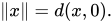
A normed vector space is a vector space equipped with a norm, which is a function that measures the length of vectors. The norm of a vector v is typically denoted by . Any normed vector space can be equipped with a metric in which the distance between two vectors x and y is given by


The metric d is said to be induced by the norm . Conversely,[16] if a metric d on a vector space X is

- translation invariant: for every x, y, and a in X; and
- absolutely homogeneous: for every x and y in X and real number α;


then it is the metric induced by the norm
A similar relationship holds between seminorms and pseudometrics.
Among examples of metrics induced by a norm are the metrics d1, d2, and d∞ on , which are induced by the Manhattan norm, the Euclidean norm, and the maximum norm, respectively. More generally, the Kuratowski embedding allows one to see any metric space as a subspace of a normed vector space.
Infinite-dimensional normed vector spaces, particularly spaces of functions, are studied in functional analysis. Completeness is particularly important in this context: a complete normed vector space is known as a Banach space. An unusual property of normed vector spaces is that linear transformations between them are continuous if and only if they are Lipschitz. Such transformations are known as bounded operators.

Comments
Post a Comment