INTRODUCTION TO GRAPH THEORY
n mathematics, graph theory is the study of graphs, which are mathematical structures used to model pairwise relations between objects. A graph in this context is made up of vertices (also called nodes or points) which are connected by edges (also called links or lines). A distinction is made between undirected graphs, where edges link two vertices symmetrically, and directed graphs, where edges link two vertices asymmetrically. Graphs are one of the principal objects of study in discrete mathematics.
Definitions[edit]
Definitions in graph theory vary. The following are some of the more basic ways of defining graphs and related mathematical structures.
Graph[edit]

In one restricted but very common sense of the term,[1][2] a graph is an ordered pair comprising:

- , a set of vertices (also called nodes or points);
- , a set of edges (also called links or lines), which are unordered pairs of vertices (that is, an edge is associated with two distinct vertices).


To avoid ambiguity, this type of object may be called precisely an undirected simple graph.
In the edge , the vertices and are called the endpoints of the edge. The edge is said to join and and to be incident on and on . A vertex may exist in a graph and not belong to an edge. Multiple edges, not allowed under the definition above, are two or more edges that join the same two vertices.


In one more general sense of the term allowing multiple edges,[3][4] a graph is an ordered triple comprising:
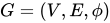
- , a set of vertices (also called nodes or points);
- , a set of edges (also called links or lines);
- , an incidence function mapping every edge to an unordered pair of vertices (that is, an edge is associated with two distinct vertices).


To avoid ambiguity, this type of object may be called precisely an undirected multigraph.
A loop is an edge that joins a vertex to itself. Graphs as defined in the two definitions above cannot have loops, because a loop joining a vertex to itself is the edge (for an undirected simple graph) or is incident on (for an undirected multigraph) which is not in . So to allow loops the definitions must be expanded. For undirected simple graphs, the definition of should be modified to . For undirected multigraphs, the definition of should be modified to . To avoid ambiguity, these types of objects may be called undirected simple graph permitting loops and undirected multigraph permitting loops (sometimes also undirected pseudograph), respectively.
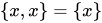




and are usually taken to be finite, and many of the well-known results are not true (or are rather different) for infinite graphs because many of the arguments fail in the infinite case. Moreover, is often assumed to be non-empty, but is allowed to be the empty set. The order of a graph is , its number of vertices. The size of a graph is , its number of edges. The degree or valency of a vertex is the number of edges that are incident to it, where a loop is counted twice. The degree of a graph is the maximum of the degrees of its vertices.


In an undirected simple graph of order n, the maximum degree of each vertex is n − 1 and the maximum size of the graph is n(n − 1)2.
The edges of an undirected simple graph permitting loops induce a symmetric homogeneous relation on the vertices of that is called the adjacency relation of . Specifically, for each edge , its endpoints and are said to be adjacent to one another, which is denoted .


Directed graph[edit]

A directed graph or digraph is a graph in which edges have orientations.
In one restricted but very common sense of the term,[5] a directed graph is an ordered pair comprising:
- , a set of vertices (also called nodes or points);
- , a set of edges (also called directed edges, directed links, directed lines, arrows or arcs) which are ordered pairs of vertices (that is, an edge is associated with two distinct vertices).

To avoid ambiguity, this type of object may be called precisely a directed simple graph. In set theory and graph theory, denotes the set of n-tuples of elements of that is, ordered sequences of elements that are not necessarily distinct.


In the edge directed from to , the vertices and are called the endpoints of the edge, the tail of the edge and the head of the edge. The edge is said to join and and to be incident on and on . A vertex may exist in a graph and not belong to an edge. The edge is called the inverted edge of . Multiple edges, not allowed under the definition above, are two or more edges with both the same tail and the same head.

In one more general sense of the term allowing multiple edges,[5] a directed graph is an ordered triple comprising:
- , a set of vertices (also called nodes or points);
- , a set of edges (also called directed edges, directed links, directed lines, arrows or arcs);
- , an incidence function mapping every edge to an ordered pair of vertices (that is, an edge is associated with two distinct vertices).

To avoid ambiguity, this type of object may be called precisely a directed multigraph.
A loop is an edge that joins a vertex to itself. Directed graphs as defined in the two definitions above cannot have loops, because a loop joining a vertex to itself is the edge (for a directed simple graph) or is incident on (for a directed multigraph) which is not in . So to allow loops the definitions must be expanded. For directed simple graphs, the definition of should be modified to . For directed multigraphs, the definition of should be modified to . To avoid ambiguity, these types of objects may be called precisely a directed simple graph permitting loops and a directed multigraph permitting loops (or a quiver) respectively.




The edges of a directed simple graph permitting loops is a homogeneous relation ~ on the vertices of that is called the adjacency relation of . Specifically, for each edge , its endpoints and are said to be adjacent to one another, which is denoted ~ .

Comments
Post a Comment